
Offside betting becomes a form of statistics that is prioritized by in-depth analysts because of its high predictive ability based on match data at U888. As VAR technology, sensor systems and tactical operations become more and more modern. Grasping the correct characteristics of this form of prediction helps readers make more accurate judgments.
Overview of offside betting information
Offside betting is a type of prediction related to the total number of offside situations in the match or the comparison between two teams. This type of statistics is measured by technology and VAR, so the level of controversy is much less than penalties or cards. Not dependent on the number of goals or unpredictable events, this type of prediction revolves around actual statistics in the match.

However, to exploit this form well, members cannot rely only on intuition. Understanding how the tracking system, VAR’s perspective, striker’s movement habits and how teams press is a must.
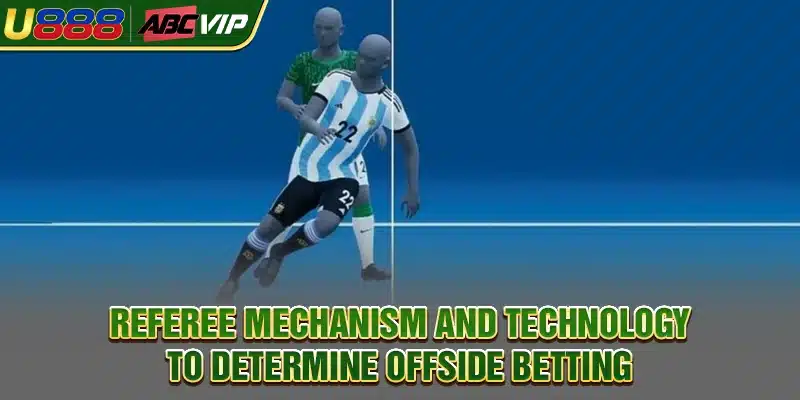
Referee mechanism and technology decide the number of offside betting
Data from offside betting is increasingly accurate thanks to VAR, a sensor system that monitors every situation on the field. The combination of technology and linesmen helps create reliable statistics, creating a clear analytical foundation for each match.
VAR & sensor system
VAR is more than just a slow motion monitoring room. In major tournaments, balls and player jerseys are equipped with sensors that record movements in milliseconds. In fact, a situation that is difficult to distinguish with the naked eye, for example, a striker only rising a few centimeters, is still accurately scanned by VAR thanks to 3D line drawing technology.
When the line is displayed, the VAR team will send information to the field for the referee to stop the game, creating a near-absolute decision. Today, an offside is determined based on:
- The moment the ball leaves the foot is recorded by the sensor.
- The legal position of each body part of the attacking player.
- Defensive lines are built using distance measuring software.
Assistant linesman
Even with the help of technology, the assistant linesman’s role remains crucial. They are required to observe three factors simultaneously: the timing of the pass, the position of the last defender and the direction of the striker’s run. Assistant linesmen are also required to hold their flag if the situation is likely to lead to a shot. The new rule is aimed at preventing premature blowing that could spoil the scoring opportunity.
Popular offside betting
Below are the most commonly used forms, which appear frequently in in-depth analysis of offside betting each form has its own advantages, suitable for each type of team.
Total number of blows predicted form
This is the most common format in tournaments with VAR. Data is taken from the entire match, including situations where the linesman keeps his flag for the system to check later. Thanks to the comprehensive recording, this format is suitable for those who analyze based on the speed of the front line. In addition, there is the organization of the pressing and the distance traveled by the lines.
Comparison of the number of fouls between two teams
This form is suitable when the two teams have a clear difference in speed or attacking style. One team uses a lot of through balls, the other team attacks slowly, prioritizes small coordination, the data difference will be easier to distinguish. In practice, experts often choose this form in:
- High defensive line vs counter-attacking team.
- The match had a fast striker, the other team played more like a possession team.
- The intense derby matches make it easy for the forwards to move early.

Form by association
The number of crossing situations in the first and second half is often not the same offside betting. The first half is often more rushed, especially in fast-paced matches. The second half starts from the 60th minute onwards, teams make substitutions, tactics change, and data fluctuates significantly. This format is especially suitable when:
- A team that has a habit of starting the game quickly, constantly stuffing the ball from the start.
- The game has a tactical setting, where the first half is often used to test the opponent’s reaction.
- Coaches often change the speedy striker in the second half, causing the number of passing situations to increase dramatically.
Time-specific form
Some matches are analysed by the first 15 minutes or the last 10 minutes, especially in fast-paced tournaments. When the game is tense, many teams play early passes to create surprises, thereby increasing the number of crosses in this period offside betting this is suitable when:
- The match had a big difference in physical strength between the players.
- A team is behind, forced to push up the entire line.
- Bad weather makes the defense unstable and easy to overcome.
Conclude
Synthesized from U888, data of offside betting clearly reflects the attacking structure and the organization of each team’s defensive system. When combining data from VAR, sensors and the operating style of the front line, analysts can more easily recognize the trend of the match. Understanding these factors correctly helps the evaluation process become more realistic and limits emotional bias.